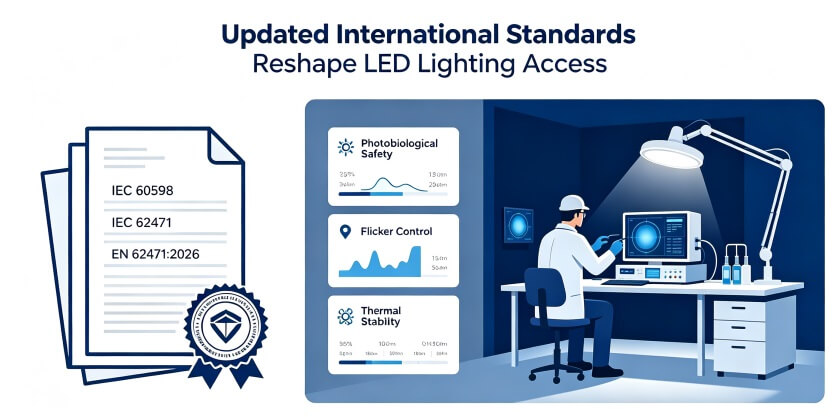
Since the beginning of 2026, a series of updated international safety and performance standards for LED lighting have been gradually implemented, significantly raising the technical thresholds for product market access. The International Electrotechnical Commission (IEC) has revised key standards including IEC 60598 and IEC 62471, strengthening requirements for photobiological safety, blue light hazard control, flicker suppression, and thermal stability of LED luminaires.
In the European Union, the revised EN 62471:2026 standard has been officially enforced since May 2026, imposing mandatory classification and labeling for blue light hazards on high‑brightness LED products. The EU’s EPBD directive requires newly built commercial buildings to be equipped with intelligent lighting control systems, making smart functions a basic configuration rather than an optional feature. Australia, India, and other countries have also introduced stricter energy efficiency and safety certification requirements for LED lighting products.
These regulatory updates push manufacturers to strengthen R&D investment in optical design, drive technology, and material innovation. Products that fail to meet the new standards will be restricted from entering major global markets. For the industry, this round of standard upgrading helps eliminate low‑quality production capacity, optimize the industrial structure, and guide the LED lighting industry toward higher quality, safer, and more reliable development.